

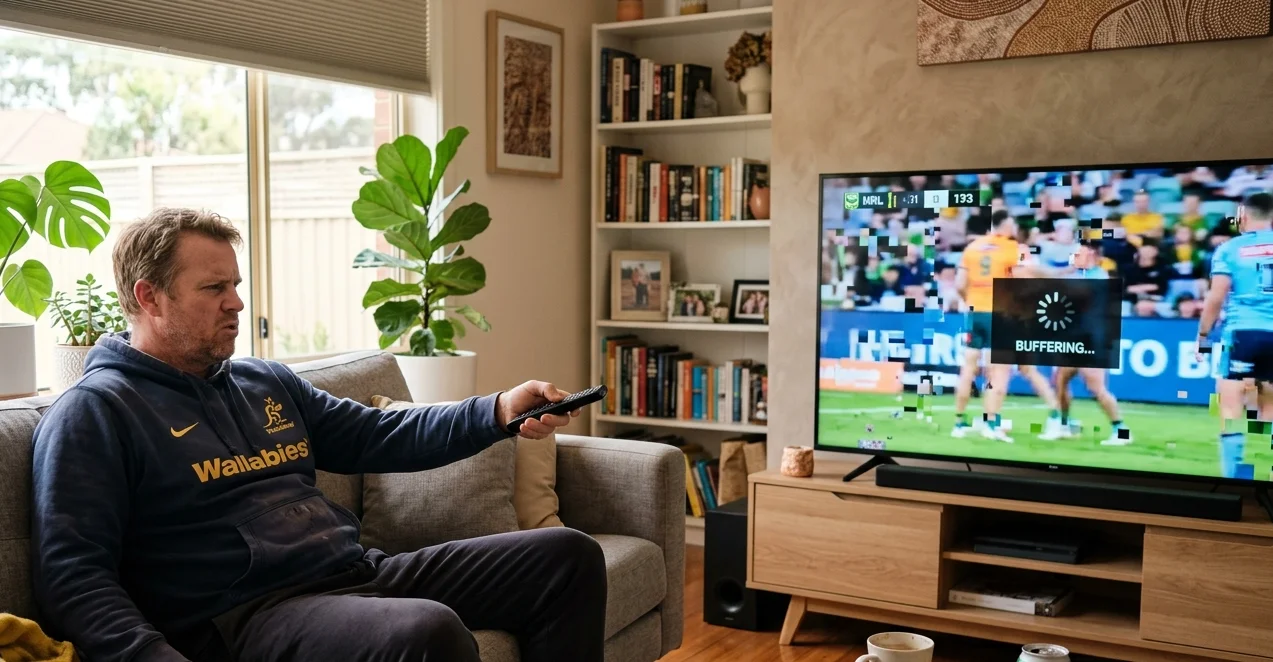
Poor TV reception is one of those problems that starts subtly and becomes progressively harder to ignore. A channel that pixelates occasionally becomes a channel that’s unwatchable most evenings. A dropout that used to happen once a week starts happening every night. And through all of it, the cause isn’t always obvious which is why so many Sunshine Coast households end up buying the wrong solution or spending money on equipment that doesn’t fix the underlying problem.
At Brocky’s TV, we assess TV reception faults across the Sunshine Coast regularly. Before recommending any solution, we measure the actual signal. Here’s how to recognise the signs that a signal booster might be what your system needs, and how to tell when it isn’t.
What a TV Signal Booster Actually Does
A TV signal booster, also called a signal amplifier, increases the strength of the antenna signal before it reaches your television. It’s designed to compensate for signal losses that occur over long cable runs, through passive splitting to multiple TV points, or in locations where the incoming signal is marginally weak.
As covered in how antenna amplifiers work in terrestrial television systems, a booster amplifies whatever signal it receives, including any noise already present in the system. This is why fitting a booster to an already poor or degraded signal can make TV reception worse rather than better — the booster amplifies the problem, not the solution.
A booster is the right answer in specific situations. Here’s how to identify whether your situation is one of them.
Clear Signs Your TV Reception Needs a Signal Booster
1. Pixelation and Dropout on Specific Channels
Digital TV reception doesn’t degrade gracefully the way analogue used to. Where an analogue signal produced a snowy but watchable picture, digital television either works perfectly or drops out entirely when signal strength falls below the minimum threshold.
Signs this is a signal strength issue:
- Specific channels pixelate or drop out while others are fine, pointing to channels on a different transmitter or frequency that your antenna is less optimised for
- Reception is fine during the day but deteriorates in the evening when atmospheric conditions change
- Pixelation worsens during adverse weather and improves when conditions clear
These patterns are classic indicators of marginal TV reception where a correctly specified booster, installed after confirming the antenna and cabling are in good condition, may lift the signal into the reliable reception range.
2. Reception Quality Varies Between TV Points in Your Home
If your TV reception is excellent on the television closest to the antenna outlet but significantly worse on televisions in other rooms, a passive splitter distributing the signal to multiple points is almost certainly the cause.
Every passive split introduces signal loss. A two-way split typically loses 3.5 dB on each output. A four-way split loses significantly more. If the incoming signal isn’t strong enough to support the number of splits in your system, the result is reliable reception at some points and poor reception at others.
Signs your splits are the problem:
- The TV closest to the main antenna outlet works well, but others don’t
- Reception deteriorated after you added a new TV point to the system
- Performance is inconsistent across rooms in a way that doesn’t correspond to weather or time of day
A correctly specified distribution amplifier compensates for split losses and restores consistent TV reception across all points in the home.
3. Reception That Drops Out Specifically During Wet Weather
TV reception that’s generally adequate but deteriorates specifically during heavy rain or high humidity is showing signs of moisture ingress into the antenna system. Water in coaxial cable connectors, particularly outdoor connections exposed to the Sunshine Coast’s coastal weather, both attenuates signal and introduces noise.
What to check:
- Inspect all outdoor connections for water ingress, corrosion, or damaged weatherproofing
- Check the antenna itself for physical damage or deterioration of the element coating
- Confirm the cable entry point into the roof cavity is properly sealed
In this situation, sealing connections and repairing moisture-affected components is the fix rather than a booster. A booster installed on a water-affected system amplifies the degraded signal without addressing the underlying cause.
4. You’re in a Fringe Reception Area on the Sunshine Coast
Properties located some distance from the Mt Cooroora or Gympie broadcast transmitter, particularly those in hilly areas or properties with significant vegetation between the antenna and the transmitter, may receive a signal that’s technically present but marginal for reliable digital TV reception.

Signs of fringe reception:
- All channels are affected consistently rather than specific channels only
- Reception is worse in the evening when atmospheric refraction changes signal propagation
- Neighbouring properties with better antenna positioning or higher antenna mounts receive better signals
A masthead amplifier, installed at the antenna itself before cable loss accumulates, is the most effective solution for fringe reception situations. It amplifies the signal at the strongest point in the system rather than trying to recover signal that’s already been attenuated over a long cable run.
For a comprehensive look at everything that causes poor TV reception beyond just signal strength, including antenna alignment, cable quality, and local interference, poor TV reception fix covers the full range of causes and solutions.
Signs You Don’t Need a Booster and Need Something Else Instead
This is the part of the conversation that prevents Sunshine Coast households from spending money on the wrong solution.
Your Antenna Is Misaligned
An antenna pointing in the wrong direction produces weak or absent signal regardless of how much amplification you add downstream. A misaligned antenna needs realignment at the source before any booster is considered.
Your Cabling or Connections Are Faulty
Damaged coaxial cable, corroded connectors, or poorly terminated inline joins introduce noise and signal loss that a booster amplifies rather than corrects. Fitting a booster to faulty cabling makes the noise louder without improving picture quality.
Your Signal Is Already Too Strong
Properties very close to a broadcast transmitter can receive a signal that’s already at or above the maximum input level for the television tuner. Adding a booster to an already over-strong signal causes picture breakup that looks identical to a weak signal fault. A professional signal meter check before any booster is purchased prevents this outcome.
Your Antenna Is Simply Inadequate for Your Location
A low-gain antenna in a fringe reception area needs replacing with a correctly specified high-gain antenna, not amplifying. Boosting an inadequate antenna produces marginal improvements at best. For comprehensive TV antenna installation on the Sunshine Coast, a site assessment determines the right antenna specification for your specific location before any hardware is purchased.
For correctly specified and professionally installed TV antenna boosters on the Sunshine Coast, Brocky’s TV covers signal assessment, booster selection, and installation with full signal testing before and after.
For further information on how ACMA manages broadcast reception standards and what Australian households can expect from their free-to-air service, ACMA’s consumer guide to TV reception provides the authoritative reference for reception performance expectations.
Why a Professional Signal Assessment Matters Before Any Purchase
The most common mistake Sunshine Coast households make with TV reception problems is buying a booster without measuring the signal first. A booster fitted to a system with a misaligned antenna, faulty cabling, or an already adequate signal makes the problem worse rather than better.
A professional signal assessment with a calibrated meter takes less than an hour and tells you:
- The incoming signal strength at the antenna
- The signal level at each TV point in the home
- Whether a booster is warranted and which type is appropriate
- Whether the antenna, cabling, or distribution equipment needs attention first
This assessment prevents money being spent on equipment that doesn’t fix the actual problem.
Why Sunshine Coast Locals Trust Brocky’s TV
We’re a local antenna service, not a national franchise. When you contact Brocky’s TV, an experienced local technician measures your actual signal levels before recommending anything. We don’t fit boosters where they’re not needed, and we don’t fit them without confirming the rest of the system is in the condition required for the booster to work effectively.
Here’s what you get with every TV reception repair on the Sunshine Coast at Brocky’s TV:
- Signal meter testing at the antenna and at every TV point before any recommendation is made
- Correct booster type specified for your specific situation and signal level
- Professional installation with all connections sealed and weatherproofed
- Full signal testing after installation to confirm the improvement
- Transparent, upfront pricing with no surprises
We’ll let the locals we’ve helped do the talking.
Book Your TV Reception Assessment Today
Don’t buy a booster based on a guess. A proper signal assessment tells you exactly what your system needs before any money is spent on hardware.
From TV reception assessments and booster installation to full antenna services across the Sunshine Coast, you can find everything we do at Brocky’s TV.
Contact Brocky’s TV today and we’ll assess your signal and recommend the right solution before anything is purchased or installed.
FAQs
1. How do I know if my TV reception problem needs a booster or a new antenna?
A signal meter test at the antenna tells you whether the incoming signal is adequate. If signal is present but marginal, a booster may help. If it’s absent or very weak, the antenna or its position needs attention first.
2. Can a TV signal booster make reception worse?
Yes. Fitting a booster to a system with faulty cabling, a misaligned antenna, or an already over-strong signal amplifies the problem rather than fixing it. A signal assessment before installation prevents this.
3. Why is my TV reception worse in the evening?
Evening atmospheric conditions cause signal propagation changes that can reduce signal strength for some locations. This is a common sign of marginal reception where a correctly specified masthead amplifier may help.
4. Does wet weather affect TV reception on the Sunshine Coast?
Yes. Heavy rain and high humidity can reduce signal strength, and moisture in outdoor cable connections causes both signal loss and noise. Sealing connections properly is the fix for moisture-related reception issues.
5. Does Brocky’s TV install signal boosters across the Sunshine Coast?
Yes. We supply, install, and configure TV signal boosters across the Sunshine Coast including Maroochydore, Caloundra, Noosa, Nambour, and surrounding areas, always after a proper signal assessment.