

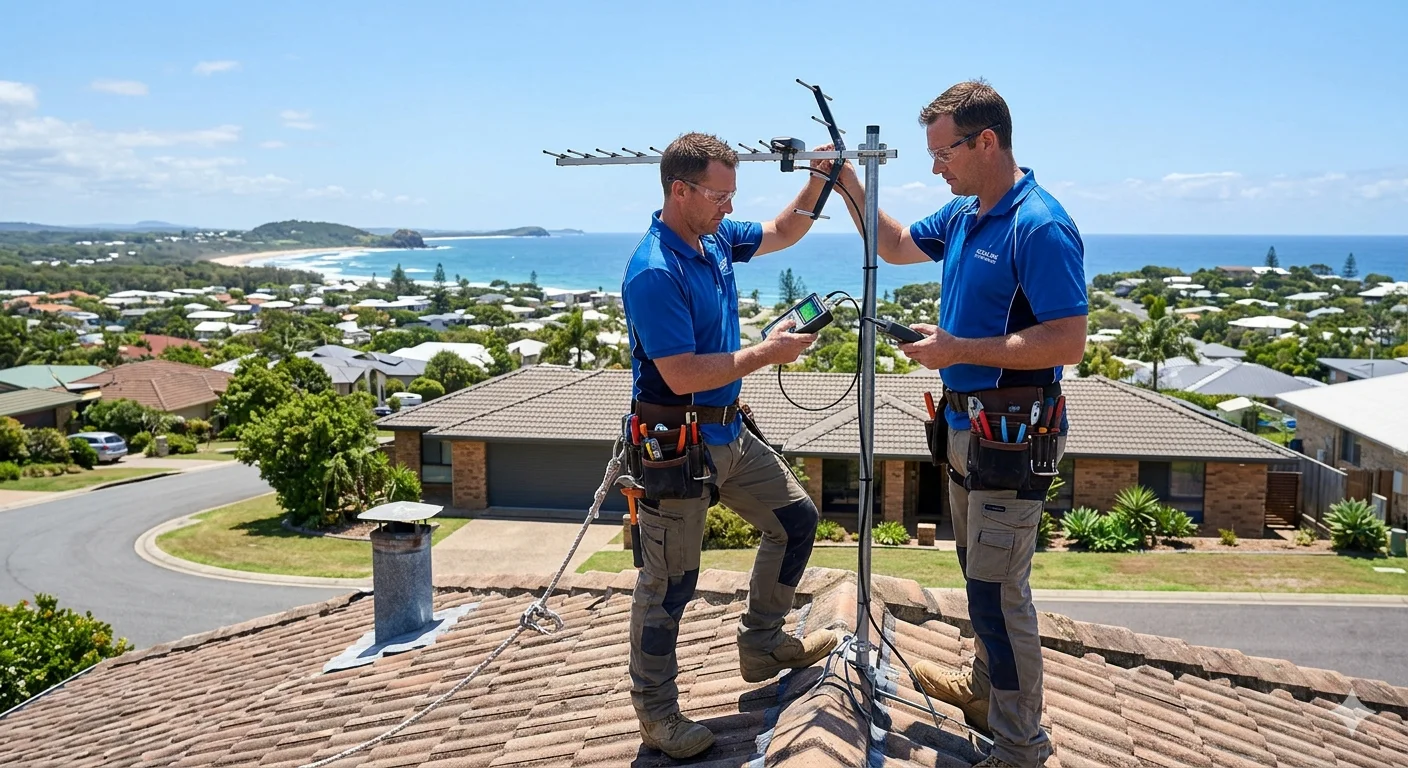
There’s nothing more aggravating than settling in to watch something, only to have the picture freeze, pixelate, or disappear entirely. Poor TV reception is one of the most common problems for Sunshine Coast households, and the frustrating part is that most causes are completely fixable once you know what you’re dealing with.
At Brocky’s TV, we diagnose and fix poor TV reception problems across the Sunshine Coast every week. Here’s a practical breakdown of the ten most common causes and what actually resolves each one.
1. Weak Antenna Signal
A signal that’s too low to meet the digital threshold is the most frequent cause of poor TV reception. Unlike the old analogue system where a weak signal gave you a fuzzy but watchable picture, digital TV is all or nothing. Below the threshold, you get pixelation, freezing, or a completely blank screen.
What causes it:
- Antenna positioned too low on the roof
- Property too far from the nearest transmitter tower
- Trees, buildings, or hills blocking the signal path
What to try: reposition the antenna higher if accessible, and check whether your neighbours have the same problem. If they do, the issue may be at the transmitter rather than your system.
2. Damaged or Loose Coaxial Cables
The coaxial cable carries your signal from the antenna down into the house and to each TV point. Any damage along that run causes signal loss, and the effect accumulates the longer the run is.
Signs your cabling is the problem:
- Picture drops in and out rather than failing completely
- Reception varies with temperature or weather
- Visible damage, kinks, or water ingress on outdoor cable sections
Replacing damaged cabling is one of the most cost-effective poor TV reception fixes available, and one of the most commonly overlooked.
3. Antenna Pointing the Wrong Direction
Your antenna needs to be aimed precisely at the correct transmitter tower. Even a minor shift from wind, storm damage, or physical disturbance during roof work can take reception from clear to completely unreliable.
Correct alignment requires a signal meter for accurate results, not an estimate by eye. For the Sunshine Coast specifically, the terrain variation between coastal areas and the hinterland means transmitter directions differ significantly between suburbs. A professional alignment with proper testing equipment is almost always the most reliable fix.
4. Signal Interference
Radio frequency interference from household electronics can disrupt digital TV signals, particularly on frequency bands that overlap with 4G mobile networks.
Common interference sources:
- LED lights with poor shielding, particularly budget LED downlights
- 4G mobile signal on frequencies adjacent to certain free-to-air channels
- Large metal structures like ducted air conditioning units near the antenna
Moving the antenna to a higher, more exposed position and ensuring proper outdoor cabling shielding reduces interference significantly.
5. Outdated Antenna Not Suited to Digital Broadcasting
An antenna installed during the analogue era may not be optimised for the frequency ranges used by digital broadcasting in your specific area. Combined with physical deterioration from Queensland’s UV exposure and salt air, these older units often can’t deliver reliable digital signal even when positioned correctly.
If your antenna is more than 10 to 15 years old, or shows visible rust and corrosion, replacement is almost always more cost-effective than trying to work around its limitations.
6. Weather Conditions

Heavy rain, storms, and strong winds affect poor TV reception in two ways: temporarily by changing how signals propagate between the transmitter and your antenna, and permanently by physically shifting your antenna’s alignment or damaging cabling and connectors.
If reception is consistently worse after wet or windy weather, a post-storm assessment is worth booking even if everything looks intact from the ground. Hidden cable damage and minor antenna shifts aren’t visible without proper testing.
For a deeper look at weather-specific reception causes, our blog on common TV reception problems and how to fix them covers weather and signal interference in detail.
7. Poor Quality Splitters and Wall Plates
Every time your antenna signal is divided to feed multiple TV points, each point receives less signal. Cheap splitters and poorly installed wall plates amplify this loss, sometimes dramatically.
Signs your distribution hardware is the problem:
- One TV in the house has good reception while others are unreliable
- Reception improves when a TV is connected directly to the antenna rather than through the wall plate
Replacing cheap splitters with quality distribution amplifiers, properly sized for the number of TV points in your home, is a straightforward and lasting fix.
8. Channels Not Tuned Correctly
Sometimes what looks like a poor TV reception problem is actually a tuning issue. Running an auto-scan while the transmitter had a temporary outage, or after antenna work was completed, can leave your TV with incomplete or incorrect channel data.
Running a full auto-scan from your TV’s setup or settings menu after any antenna work, or after suspected transmitter issues, takes a couple of minutes and occasionally resolves problems that seem more serious.
9. Indoor Antenna Limitations
Indoor antennas are a compromise in almost all situations, particularly in Caloundra, Buderim, or any hinterland area where signal paths are longer or more obstructed. They can’t compete with a properly installed outdoor antenna for signal strength and consistency.
If you’re currently using an indoor antenna and experiencing persistent poor TV reception, switching to a correctly installed outdoor unit is typically the single most impactful change available.
Our smart TV setup service integrates antenna performance assessment with the full TV and streaming configuration for Sunshine Coast households wanting everything working properly from the start.
10. Incorrectly Sized or Faulty Signal Amplifier
A signal amplifier can help when the incoming signal is genuinely weak, but the wrong amplifier, or an amplifier installed where one isn’t needed, causes as many problems as it solves. Over-amplification saturates the tuner in your TV, increasing noise and distortion rather than improving clarity.
A professional signal test before any amplification is installed confirms whether a booster will help or hurt. The ACMA’s TV reception guidance for Australian households outlines the signal levels that determine whether amplification is appropriate.
When to Call a Professional
Basic troubleshooting, including antenna repositioning, cable checks, and retuning, resolves some poor TV reception problems. Others need professional signal testing to identify the actual cause before any fix is attempted.
The team at Brocky’s TV carries out full signal assessments, antenna alignments, cabling inspections, and complete antenna replacements across the Sunshine Coast, with upfront pricing before any work begins.
See what other Sunshine Coast locals think of our work by reading what our customers say before you book.
Call us on 0754059022, Monday to Friday during business hours.
Contact us today to book your signal assessment or get a no-obligation quote on any antenna work across the Sunshine Coast.
FAQs
1. What is the most common cause of poor TV reception on the Sunshine Coast?
Weak or degraded antenna signal is the most frequent cause, whether from an old or damaged antenna, misalignment after a storm, or aged cabling that’s losing signal along the run. A professional signal test identifies which factor applies to your specific property.
2. Will retuning my TV fix poor reception?
Retuning fixes missing channels caused by incorrect tuning data, but it won’t resolve physical signal problems like antenna damage, misalignment, or cabling faults. It’s always worth trying as a first step.
3. How do I know if my antenna needs replacing or just realigning?
Professional signal testing at the antenna point and at your TV reveals this quickly. Strong signal at the antenna but weak at the TV suggests cabling or distribution issues. Weak signal at the antenna points to alignment or the antenna itself.
4. Can the type of roof affect my TV reception?
Yes. Metal roofing can reflect or interfere with signals, and tile or Colorbond roofs affect how cables are run. These factors influence the best antenna mounting position, which is why site assessment before installation matters.
5. Why does my TV reception vary throughout the day?
Temperature changes affect how signals travel from the transmitter, and atmospheric conditions during certain weather patterns can strengthen or weaken signals. If variability is consistent rather than random, a marginal signal issue is usually the cause.