

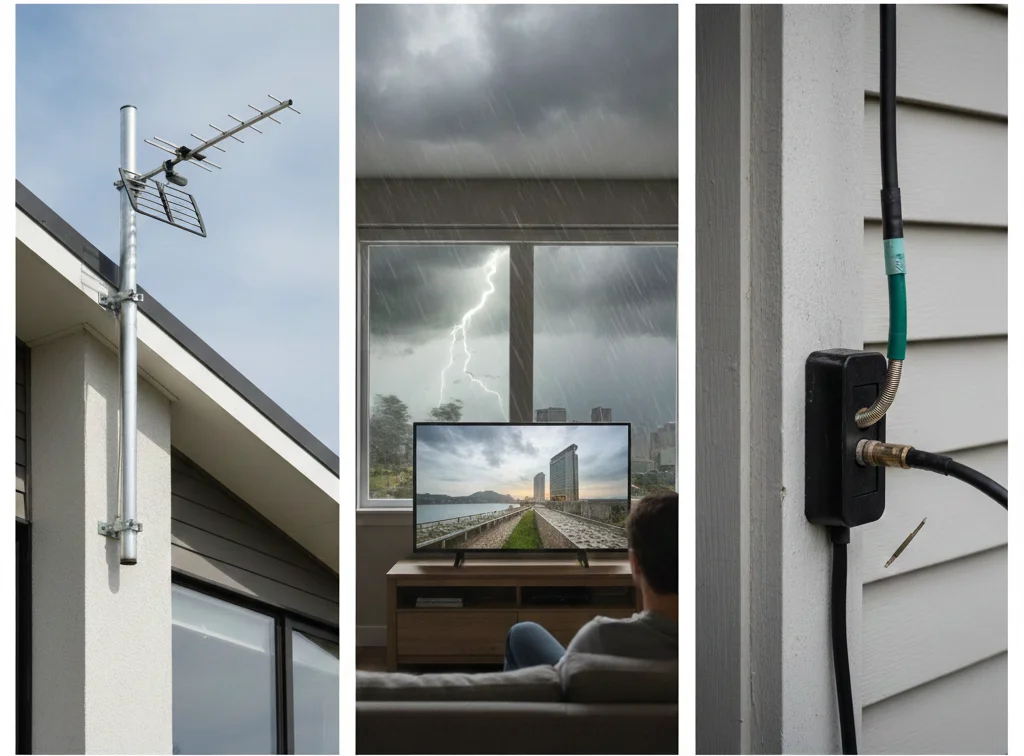
Queensland’s weather is stunning most of the year. But when a summer storm rolls in off the coast or the humidity climbs during wet season, your TV signal can go from crystal clear to unwatchable in minutes. If your reception consistently drops during bad weather, you’re not imagining it, and the cause is usually something very specific and very fixable.
At Brocky’s TV, TV signal repair Sunshine Coast wide is something we deal with every week, and weather-related reception problems are among the most common calls we receive. Here’s a clear explanation of what’s happening to your TV signal during bad weather, and what can actually be done about it.
Why Bad Weather Affects TV Signal
Digital TV broadcasts travel as radio waves from the transmitter tower to your antenna. Like all radio waves, they’re affected by the atmosphere between the transmitter and your home. Under normal conditions, that path is relatively clear and your TV signal arrives at consistent strength.
Several weather conditions disrupt that path in different ways, each producing different symptoms in your reception.
Heavy Rain and Moisture
Rain doesn’t directly block TV signal the way it might seem. The issue is more subtle. Heavy rainfall increases atmospheric moisture, which affects how radio waves propagate between the tower and your antenna. The result is a reduction in effective signal strength, particularly on channels that were already receiving marginal signal under normal conditions.
Moisture is also a long-term threat to outdoor antenna components. Water ingress at cable joins and connectors, condensation inside coaxial cable, and corrosion on antenna elements all reduce TV signal quality permanently over time, not just during rain events.
Weatherproof connectors, sealed cable entries, and UV-rated outdoor cabling are the practical protection against these effects. If your antenna system was installed more than ten years ago, the outdoor cabling and connectors have likely deteriorated to the point where moisture is already a factor in your day-to-day reception.
Wind and Antenna Shift
Even a modest shift in antenna direction causes noticeable TV signal degradation on digital broadcasts. The reason is the precision required for digital reception. A few degrees off-alignment on an analogue system produced a slightly grainier picture. On digital, the same shift can push signal below the reception threshold and produce complete blackout or constant pixelation.
Strong winds on the Sunshine Coast, particularly during storm season, regularly shift antennas from their optimal alignment. This is especially common with older installations where the mounting hardware has rusted or loosened over years of UV and salt air exposure.
In many cases, the antenna looks perfectly fine from the ground but has moved enough to cause significant signal loss. Professional signal testing reveals this immediately.
Atmospheric Ducting
This is a less commonly known cause of TV signal disruption that’s particularly relevant on the Sunshine Coast. Atmospheric ducting occurs when weather conditions cause radio waves to bend and travel differently than normal, sometimes carrying signals from distant transmitters that interfere with the local signal on the same or adjacent frequencies.

During certain weather patterns, Sunshine Coast households experience reception problems caused by signals from interstate or other Queensland transmitters temporarily overpowering the local broadcast. This type of interference is temporary and resolves when weather conditions normalise.
Lightning and Surge Damage
A nearby lightning strike during a storm can cause surge damage to antenna components even without a direct strike. An unearthed antenna system provides a path for induced voltage to travel into connected equipment, sometimes damaging the antenna booster, the coaxial cable, or the TV’s tuner circuit.
The ACMA’s guidance on TV antenna earthing and safety outlines the requirements for proper antenna earthing, which is one of the most commonly skipped steps in antenna installation and one of the most important for protecting equipment during storm season.
What to Do When Your TV Signal Drops During a Storm
During the Storm
- Don’t attempt to adjust or move outdoor antenna components during a storm
- If lightning is close, consider unplugging your TV from the wall entirely as a precaution
- Check whether your neighbours are experiencing the same issue, which suggests a transmitter-level problem rather than your antenna
After the Storm
- Check all visible cable connections at the TV and wall plate for moisture
- Run a full auto-scan on your TV to refresh the channel list, signal changes during the storm may have affected stored channel data
- Look for obvious physical changes to the antenna or cabling if you have safe roof access
If reception doesn’t return to normal within an hour or two of the storm clearing, there’s a fault in your antenna system that needs professional attention.
Preventing Weather-Related TV Signal Problems
Upgrade Your Cable and Connectors
The most impactful preventive step for most older Sunshine Coast antenna installations is replacing aged coaxial cable and outdoor connectors. Modern RG6 cable with UV-resistant outer sheathing and properly crimped weatherproof connectors dramatically reduces moisture-related signal loss.
Add a Quality Signal Booster
For properties where the TV signal is already operating with limited margin above the digital threshold, weather-related fluctuations push it below the cutoff. A properly specified signal booster brings the overall signal level up, creating more headroom to absorb weather-related losses without dropping below the reception threshold.
Our TV antenna booster service includes signal testing before any amplification is recommended, confirming whether a booster will genuinely help in your specific situation.
Ensure Correct Antenna Earthing
Proper earthing is the primary protection against surge damage during storms. If your existing antenna installation doesn’t include earthing, adding it is a worthwhile investment before the next storm season.
Consider a Higher-Gain Antenna for Your Location
Some Sunshine Coast properties are operating on a TV signal that’s adequate under ideal conditions but vulnerable to any weather-related degradation. Upgrading to an antenna with higher gain for your specific location and distance from the transmitter creates more signal margin and reduces weather sensitivity significantly.
For new Sunshine Coast homes where this infrastructure can be planned from the start, our new home antenna service designs the system specifically for long-term reliability in Queensland conditions.
After a Storm: Checking Whether Damage Has Occurred
One of the most common mistakes after a significant storm event is assuming everything is fine because the TV is showing some signal. A system that’s been partially damaged by a storm or surge may still function on strong channels but fail on weaker ones, or produce marginal reception that deteriorates progressively as internal damage develops.
For a comprehensive walkthrough of what professional antenna installation involves and how it protects against these issues, our overview of what professional TV antenna installation includes covers the process in detail.
A post-storm professional inspection is worth booking particularly if:
- Reception is noticeably worse than before the storm even after conditions clear
- Some channels have disappeared while others still work
- You can hear a faint buzzing or crackling through the TV’s speakers
- The antenna or mounting looks visibly shifted from the ground
The television antenna system on your roof is designed to withstand Queensland weather, but only when it’s in good condition and properly installed. Storm damage to ageing or improperly installed systems is very common on the Sunshine Coast, and catching it early prevents the gradual deterioration that leads to persistent poor reception.
Book Your TV Signal Repair on the Sunshine Coast
If your TV signal hasn’t recovered after a storm, or if bad weather consistently produces reception problems at your property, the team at Brocky’s TV is ready to diagnose and fix the cause properly.
See what other Sunshine Coast locals think of our work by reading what our customers say before you book.
Call us on 0754059022, Monday to Friday during business hours.
Contact us today to book your TV signal repair Sunshine Coast wide or get a no-obligation quote on any antenna or reception work.
FAQs
1. Why does my TV signal drop during rain even though my antenna looks fine?
Heavy rain increases atmospheric moisture which affects how radio waves travel between the transmitter and your antenna. If your signal was already close to the digital threshold, this atmospheric change can push it below the point where your TV can process the signal. Marginal signal is the underlying cause, not the rain itself.
2. Will my TV signal recover after a storm without any action?
Temporary signal drops caused by atmospheric conditions during the storm itself usually resolve once the weather clears. If signal remains poor after the storm has passed, physical damage to your antenna system or a change in alignment has likely occurred.
3. Can lightning damage my TV antenna without a direct strike?
Yes. Nearby lightning induces surge voltages in outdoor antenna systems, which can travel down the coaxial cable to connected equipment. Proper antenna earthing is the most effective protection against this type of damage.
4. Does a TV antenna booster help during bad weather?
Yes, if the underlying signal level is adequate. A booster creates more margin above the digital reception threshold, making the signal more resilient to weather-related fluctuations. It won’t help if the antenna itself is damaged or misaligned.
5. How do I know if my antenna shifted during a storm?
If reception was fine before the storm and hasn’t fully recovered after, and especially if some channels work while others don’t, alignment shift is likely. Signal testing is the most reliable way to confirm whether the antenna is pointing correctly.