

You sit down for the footy, your favourite series, or the evening news, and the screen pixelates, freezes, or the channel disappears entirely. Before you rush out and buy a TV signal booster, it’s worth understanding what’s actually causing the problem. Because sometimes a booster is exactly what you need, and sometimes it’s the last thing that will help.
At Brocky’s TV, we carry out antenna and signal assessments across the Sunshine Coast every week. Here’s an honest breakdown of the five most common causes of poor signal, when a TV signal booster is the right fix, and when something else entirely needs attention first.
What Is a TV Signal Booster and How Does It Work?
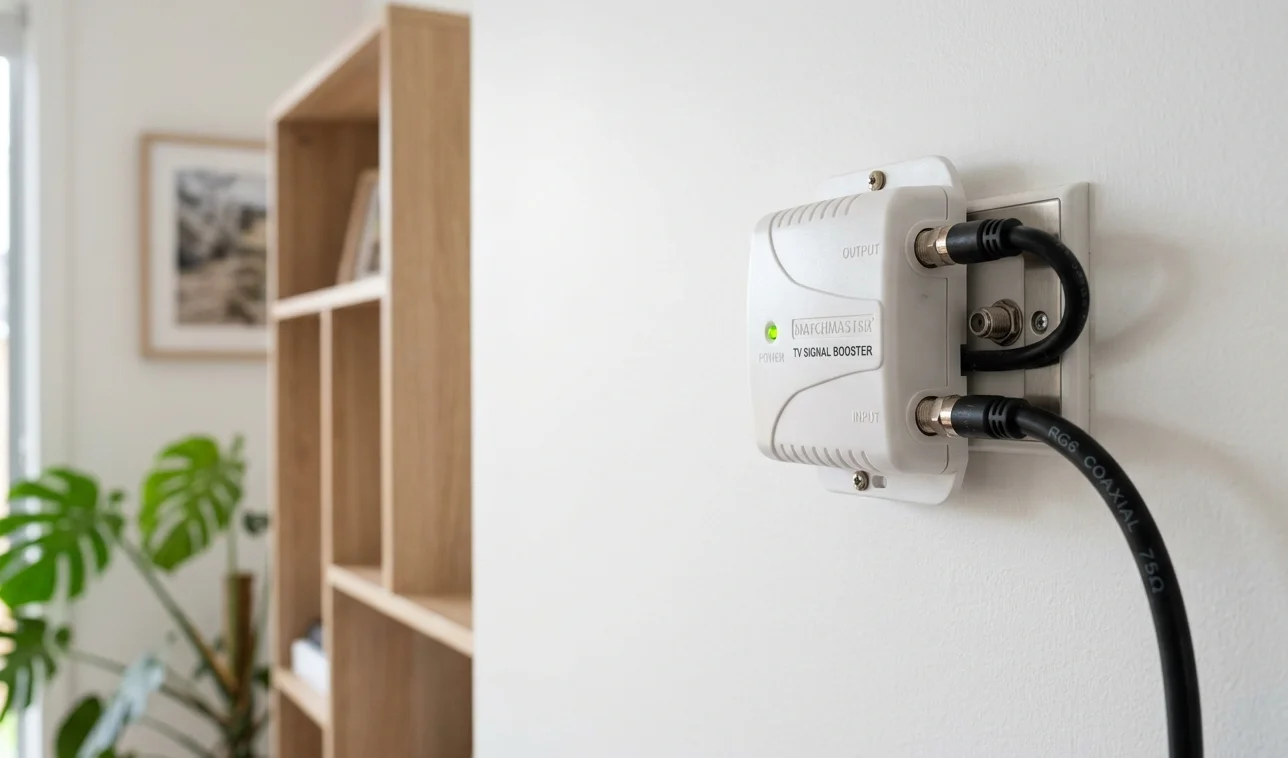
A TV signal booster, also called an antenna amplifier, is a device installed in your coaxial cable line that amplifies the signal coming from your antenna before it reaches your TV. As explained in Wikipedia’s overview of antenna amplifiers, a booster increases signal strength to compensate for losses caused by long cable runs, splitters, or weak incoming signal from a distant transmitter.
The important thing to understand is this: a TV signal booster amplifies whatever signal is already there. If the signal coming into your system is clean and just too weak, a booster solves the problem. If the signal is noisy, distorted, or absent because of a fault in your system, a booster amplifies the problem right along with it.
Getting the diagnosis right before installing any amplification is essential. That’s exactly why professional signal testing matters so much.
5 Reasons Your TV Signal Is Weak on the Sunshine Coast
1. Your Antenna Is Damaged or Too Old
Your outdoor antenna is exposed to Queensland’s UV radiation, coastal salt air, high winds, and storm season year-round. Over time, elements corrode, housings crack, and the internal connections that carry your signal degrade. A damaged or aged antenna is one of the most common causes of weak signal we see across the Sunshine Coast.
Signs your antenna needs attention:
- Visible rust, corrosion, or broken elements
- Antenna that’s shifted position after a storm
- Equipment more than 10 years old
- Gradual signal drop with no other obvious cause
In this situation, a TV signal booster alone won’t fix the problem. The antenna needs to be repaired or replaced first. Our TV signal booster and upgrade service includes a full system assessment before any amplification is recommended, so you’re not paying for a fix that won’t work.
2. Loose, Damaged, or Aged Coaxial Cabling
Even a perfect antenna won’t deliver strong signal if the coaxial cable carrying it into your home is cracked, kinked, or corroded at the connectors. Cabling faults are one of the most commonly overlooked causes of signal problems on the Sunshine Coast, particularly in older properties.
What to look for:
- Frayed or cracked cable insulation, especially in roof cavities
- Loose connections at wall plates, splitters, or the TV
- Water ingress into outdoor joins or connectors
- Signal that varies with temperature or wet weather
Installing a TV signal booster on top of a faulty cable run simply amplifies the noise the damaged cable is introducing. The cabling needs to be fixed or replaced first.
3. Incorrect Antenna Alignment or Positioning
A TV antenna must be pointed accurately at the right transmitter tower to work properly. If your antenna shifted after a storm, was never correctly aligned during installation, or is obstructed by trees or new structures nearby, your signal will be inconsistent regardless of whether you have a booster installed.
The Sunshine Coast’s varied terrain, including its hilly hinterland and coastal geography, means antenna positioning matters more here than in flat suburban areas. Professional alignment using a signal strength meter is the only reliable way to confirm your antenna is correctly pointed.
Our local TV antenna service includes precision alignment for exactly this reason.
4. Signal Interference From Electronics or Structures
Digital TV signals can be disrupted by physical obstructions and electronic interference alike. New buildings, large trees, hills, and 4G or 5G mobile signals can all degrade reception, particularly on channels that share frequency bands with mobile networks.

Common interference causes on the Sunshine Coast:
- New structures or vegetation grown into the signal path
- 4G interference on certain free-to-air channels
- Cheap or unshielded splitters introducing noise
- Electrical devices near TV cabling
In interference situations, a TV signal booster is rarely the right solution. The ACMA’s TV reception troubleshooting resource provides useful guidance on identifying and addressing interference before spending money on amplification equipment.
5. Distributing Signal Across Multiple TVs
This is one scenario where a TV signal booster genuinely helps. Every time you split your antenna signal to feed an additional TV, you reduce the signal strength available to each set. A quality distribution amplifier compensates for this loss and ensures every TV in the house receives a strong, clean signal.
If your reception is fine on one TV but weak on others in different rooms, signal splitting is almost certainly the cause. A properly sized distribution amplifier installed at the right point in your cable run is the correct fix here.
When a TV Signal Booster Actually Helps
To be clear, there are genuine situations where a TV signal booster is exactly the right solution:
- You live in a fringe reception area where the incoming signal is genuinely weak
- You’re splitting signal to multiple TVs and picture quality is dropping on some sets
- Your cable run is very long and signal is being lost over the distance
- Signal testing confirms your levels are below the acceptable threshold
And situations where a booster won’t help, and may make things worse:
- Your antenna is physically damaged or misaligned
- Your coaxial cabling has faults introducing noise
- You’re already receiving a strong signal and the issue is elsewhere
- Electronic interference is the root cause
Getting this distinction right is what separates a fix that works from money wasted on equipment that doesn’t solve anything.
What to Try Before Calling a Technician
A few simple steps are worth trying first:
- Retune your TV fully by running a complete auto scan from the setup menu
- Check all visible cable connections at the TV, wall plate, and splitter boxes
- Restart your TV and set-top box completely
- Check whether neighbours are experiencing the same issue, which points to a transmitter problem
For a more detailed walkthrough, our blog onthe most common reasons your TV signal is poor covers each one in detail.
If the basics don’t resolve it, a professional signal test is the fastest and most reliable way to identify exactly what’s wrong.
Why Sunshine Coast Households Trust Brocky’s TV
We don’t recommend a TV signal booster unless signal testing confirms it will actually help. Our technicians measure signal levels at your antenna, along your cable run, and at each TV point before making any recommendation. That means you only pay for work that solves the problem.
Explore our complete range of antenna and reception services at Brocky’s TV.
See what other Sunshine Coast households think of our work by checking out what our customers say before you get in touch.
Book Your Signal Assessment Today
Don’t guess at the fix. Call Brocky’s TV and let us test your signal properly before recommending any solution.
Call 0754059022, Monday to Friday during business hours.
Contact us today to book your signal assessment or get a no-obligation quote on any antenna or booster work across the Sunshine Coast.
FAQs
1. Will a TV signal booster fix pixelation and freezing?
Only if weak signal is the actual cause. If the problem is a damaged antenna, faulty cabling, or interference, a booster will make things worse. A signal test identifies the real cause first.
2. How do I know if I need a booster or a new antenna?
Professional signal testing is the only reliable way to know. Strong signal at the antenna but weak at the TV points to a booster or cabling fix. Weak signal at the antenna means the antenna itself needs attention.
3. Can I install a TV signal booster myself?
Basic plug-in boosters are easy to connect, but without signal testing you risk over-amplifying or masking a fault that needs proper repair. Professional installation gets it right first time.
4. Why does my signal drop on certain channels but not others?
Different channels broadcast on different frequencies. Losing specific channels usually means antenna optimisation or 4G interference on that frequency band, a common issue on the Sunshine Coast.
5. What is the difference between a preamplifier and a distribution amplifier?
A preamplifier boosts signal near the antenna before cable losses occur. A distribution amplifier compensates for signal loss when splitting to multiple TVs. Your setup may need one or both.