

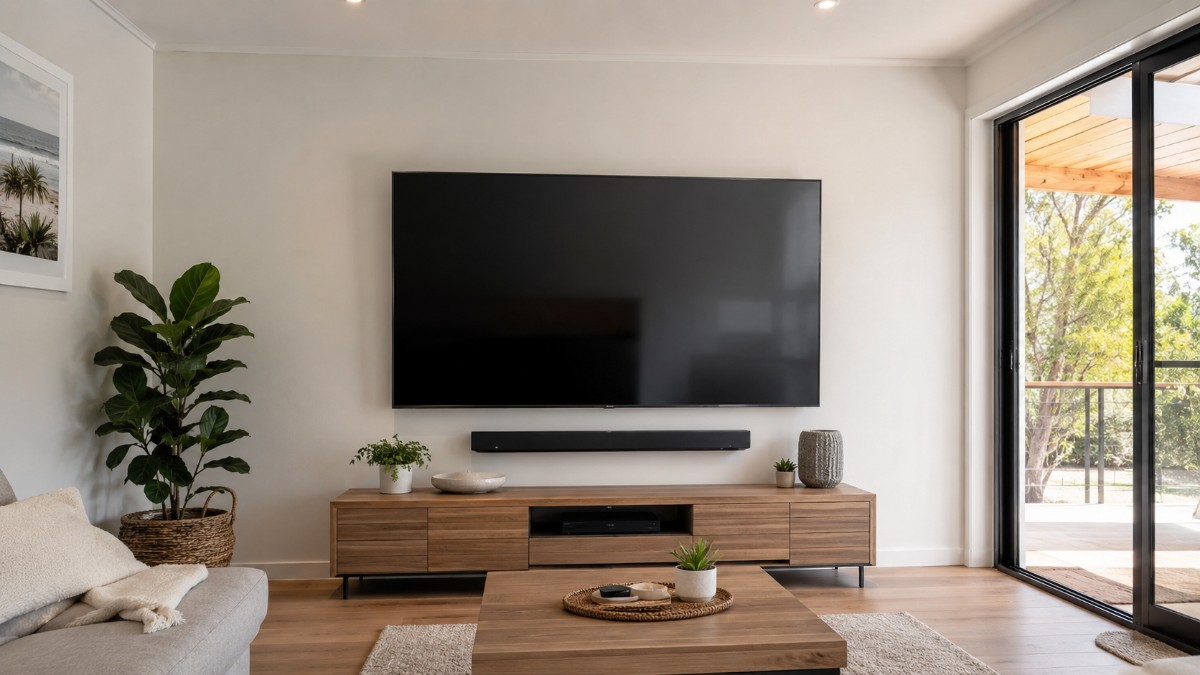
Nothing undermines a beautifully wall-mounted television faster than a bundle of cables dangling down the wall beneath it. If you’ve recently decided to hide TV cables on a wall or you’re planning a wall mount installation on the Sunshine Coast, getting the cable management right is what separates a setup that looks professionally done from one that looks like a DIY afterthought.
The good news is that there are several effective ways to hide TV cables on a wall in Australian homes, ranging from simple surface-mounted solutions to full in-wall concealment. The right approach depends on your wall type, your rental situation, and how clean a finish you want. At Brocky’s TV, we handle professional TV wall mounting on the Sunshine Coast regularly, and cable management is always part of the job. Here’s everything you need to know.
Why Cable Management Matters More Than You Think
A wall-mounted television is one of the most impactful upgrades you can make to a living room. But visible cables running down the wall draw the eye immediately and undo most of the visual benefit of mounting the TV in the first place.
Beyond aesthetics, loose cables create tripping hazards, collect dust, and are a safety concern in homes with young children. Taking the time to hide TV cables on a wall properly is worth every bit of effort it requires.
1: In-Wall Cable Concealment (The Cleanest Finish)
In-wall cable management involves running all cables inside the wall cavity between the television and the power and signal sources below. It produces a completely flush finish with no visible cables or conduit at all the TV appears to float on the wall with nothing attached.
What’s involved:
- A licensed electrician relocates a power point directly behind the television
- Cables are run through the wall cavity using a fish tape or cable rod
- The television connects to the power and signal sources through the wall with no external cable visible
Important note for Australian homes:
In-wall power relocation must be carried out by a licensed electrician. This isn’t a DIY job under Australian electrical safety regulations. The low-voltage signal cables HDMI, antenna, and audio can be run in-wall without an electrician, but the power circuit must be handled by a qualified tradesperson.
This option suits homes where the wall is plasterboard with accessible cavity space. Brick and concrete walls require alternative approaches.
2: Surface-Mounted Cable Conduit (Practical and Renter-Friendly)
Surface-mounted cable ducts, also called cable raceways or cable management channels, are plastic or metal channels that attach to the wall surface and conceal cables inside. They’re significantly more accessible than in-wall concealment and suitable for rental properties where permanent modifications aren’t permitted.
What to look for:
- Paint-grade conduit that can be painted to match your wall colour for the cleanest result
- Flat profile channels that sit close to the wall surface rather than protruding
- Corner pieces and joiners that allow the conduit to change direction cleanly around skirtings and architraves
Surface-mounted conduit is the practical solution for brick walls, rental properties, and situations where in-wall work isn’t feasible. Done well, it produces a tidy finish that reads as intentional rather than improvised.
3: Furniture and Cabinetry Integration
For homes where a floating shelf or wall-mounted cabinet sits beneath the television, cables can be routed through the cabinet itself and managed internally, keeping them completely out of sight without any wall modifications at all.
How it works:
- The TV connects to equipment housed in the cabinet below
- Cables pass through a purpose-made aperture or cable port in the cabinet’s top panel
- All source equipment streaming devices, set-top boxes, gaming consoles remains in the cabinet
This approach is particularly effective when combined with a floating TV unit that’s wall-mounted at the same time as the television, producing a fully integrated look.
How to Hide TV Cables on a Wall: Step-by-Step Overview
Regardless of which method you choose, the process follows the same sequence:
- Plan the route — identify where each cable needs to run and measure the distance
- Confirm the wall type — plasterboard allows in-wall work, brick and masonry require surface solutions
- Identify power requirements — confirm whether a new power point behind the TV is needed
- Select your concealment method — in-wall, conduit, or furniture integration
- Run the cables — starting from the television and working down to source equipment
- Test before finishing — confirm all connections are working before sealing conduit or making permanent fixes
- Paint or finish as required — paint-grade conduit should be painted to match the wall before final cable installation
As covered in how structured cabling and cable management are approached in residential installations, proper planning of cable routes before installation avoids rework and produces a cleaner result regardless of the concealment method used.
TV Wall Mounting Sunshine Coast: Getting the Full Setup Right
If you’re planning to hide TV cables on a wall as part of a new television installation, it makes sense to get the mounting and cable management done at the same time by a single professional. On the Sunshine Coast, most homes we work in are plasterboard construction, which makes both in-wall and conduit solutions practical depending on the household’s preference.

For professional TV wall mounting on the Sunshine Coast, Brocky’s TV handles the full installation from bracket selection and structural assessment through to cable management and final signal testing.
The Australian Communications and Media Authority (ACMA) advises using a registered cabler for regulated communications cabling work and highlights the importance of complying with the relevant cabling rules and standards.
Common Mistakes When Hiding TV Cables on a Wall
Not planning for future changes
Install more cable capacity than you currently need. Running a spare HDMI cable and a spare power circuit through the wall at the same time costs almost nothing extra and saves significant disruption later.
Choosing the wrong conduit profile
Oversized conduit looks worse than no conduit at all. Choose a profile that’s just large enough for the cables you’re running with a little room for future additions.
Skipping the paint step on conduit
Unpainted conduit is the most common reason surface-mounted cable management looks unfinished. Paint-grade conduit painted to match the wall reads as architectural detail rather than an afterthought.
Attempting in-wall power work without a licensed electrician
This is both illegal and genuinely dangerous in Australia. Always engage a licensed electrician for any in-wall mains wiring, regardless of how straightforward it appears.
Why Sunshine Coast Locals Trust Brocky’s TV
We’re a local service, not a national franchise. When you book Brocky’s TV, an experienced local technician handles your television mounting and cable management as a single integrated job, leaving your wall looking exactly the way it should.
Here’s what you get with every installation at Brocky’s TV:
- Professional assessment of your wall type and the most suitable cable management approach
- Full cable management included as standard with every TV wall mount
- Honest advice on in-wall versus surface solutions for your specific situation
- Clean, paint-ready conduit installation where in-wall work isn’t practical
- Transparent, upfront pricing with no surprises
We’ll let the locals we’ve helped do the talking.
Get a Clean, Cable-Free TV Setup Today
Don’t settle for cables dangling down your wall. Whether it’s a simple conduit solution or full in-wall concealment, the team at Brocky’s TV delivers a finish that looks like it was always meant to be there.
From helping you hide TV cables on a wall to full television mounting and Smart TV setup across the Sunshine Coast, you can find everything we do at Brocky’s TV.
Contact Brocky’s TV today and we’ll have your television mounted and your cables managed cleanly in a single visit.
FAQs
1. Can I hide TV cables on a wall myself in Australia?
Low-voltage cables like HDMI, antenna, and audio can be run in-wall as a DIY project. Any in-wall power relocation must be carried out by a licensed electrician under Australian electrical safety regulations.
2. What is the cheapest way to hide TV cables on a wall?
Surface-mounted cable conduit is the most affordable approach. Paint-grade conduit painted to match your wall produces a clean result at a fraction of the cost of in-wall work.
3. Does Brocky’s TV include cable management with wall mounting?
Yes. Cable management is included as standard with every professional TV wall mounting service on the Sunshine Coast.
4. Can TV cables be hidden on a brick wall?
Yes, using surface-mounted conduit. In-wall concealment isn’t practical for brick walls without significant renovation work, but well-installed conduit produces a clean finish.
5. How long does professional TV mounting and cable management take?
Most residential installations including cable management are completed within one to two hours depending on the complexity of the cable route.