

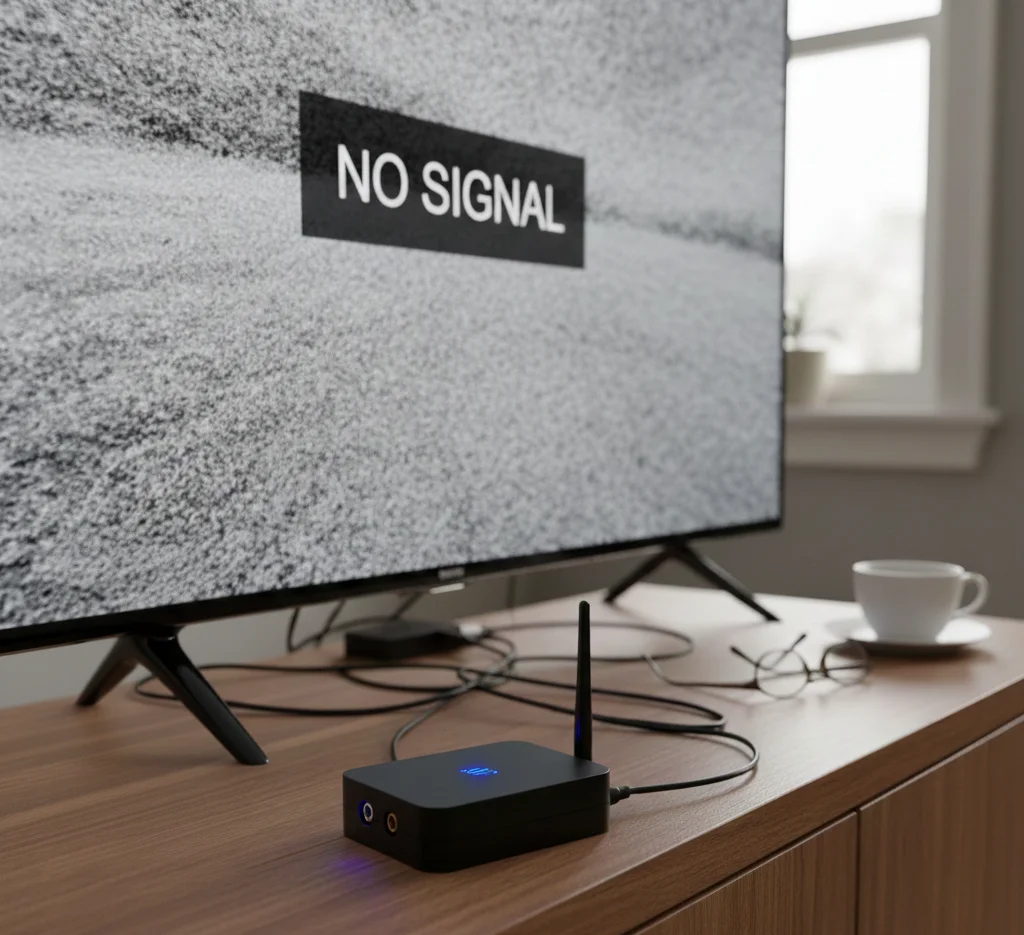
Pixelated picture. Channels that drop out during the evening. Free-to-air programs that freeze at the worst possible moment. If any of these sound familiar, you’ve probably wondered whether a TV signal booster would fix the problem. The honest answer is that sometimes it will, and sometimes it won’t and fitting the wrong solution can actually make things worse.
At Brocky’s TV, we install and configure TV signal boosters on the Sunshine Coast regularly. We also see plenty of boosters that were installed without a proper signal assessment and made the original problem significantly worse. Here’s a clear, practical guide to help you understand whether a booster is what you actually need.
What Is a TV Signal Booster and What Does It Do?
A TV signal booster, sometimes called a signal amplifier or distribution amplifier, is a device that amplifies the antenna signal before it reaches your television. It’s designed to compensate for signal losses that occur over long cable runs, through passive splitters, or in locations where the incoming signal is too weak to reliably drive multiple TV points.
As covered in how antenna amplifiers work in terrestrial television reception systems, a booster increases signal strength but also amplifies any noise present in the signal, which is why fitting one to a system with an already poor or distorted signal can reduce picture quality rather than improve it.
This is the critical point most retailers won’t tell you: a TV signal booster is a tool for amplifying an adequate signal, not for fixing a fundamentally broken reception system.
Signs You Might Genuinely Need a TV Signal Booster
A booster is the right solution in specific circumstances. Here’s when it genuinely helps.
1. You Have Multiple TV Points From a Single Antenna
Every time your antenna signal is split to serve an additional television, you lose signal strength. A passive two-way splitter typically introduces a 3.5 dB loss on each output. A four-way split introduces significantly more. If your home has three or more TV points all running from a single antenna and some of those points are producing poor reception, a correctly specified distribution amplifier is almost certainly the right fix.
Signs this applies to your home:
- Reception quality varies noticeably between different TV points in the home
- Points further from the antenna consistently produce worse picture quality
- Adding a new TV point caused reception to deteriorate on existing points
2. You Have Long Cable Runs
Coaxial cable attenuates signal over distance. The longer the cable run between your antenna and your television, the more signal is lost before it reaches the tuner. In larger Sunshine Coast homes or properties where the television is far from the antenna connection point, a masthead amplifier installed close to the antenna itself compensates for this cable loss before it accumulates.
3. Your Signal Is Marginally Weak
If a signal meter reading shows your incoming signal is slightly below the threshold for reliable digital reception but the antenna, cabling, and connections are all in good condition, a TV signal booster can lift a marginal signal into the reliable reception range.
Signs this might be your situation:
- Reception is generally adequate but drops out during adverse weather
- You’re in a fringe reception area some distance from the Mt Cooroora or Gympie transmitter
- Reception is consistently worse in the evening when network load increases
For a detailed look at how weather specifically affects your signal and when a booster helps versus when it doesn’t, is weather affecting your TV signal? How a booster can help covers the weather-signal relationship in full.
When a TV Signal Booster Won’t Help
This is the part of the conversation most people don’t have until after they’ve bought a booster that didn’t fix anything.
1. Your Signal Is Already Too Weak or Non-Existent
If the incoming signal from your antenna is below the minimum threshold for digital reception, amplifying it doesn’t help. You’re amplifying a signal that’s already too degraded to produce a clean picture. The result is a louder version of the same bad signal, which digital tuners handle no better than the original.
In this situation, the fix is improving the antenna system itself, not adding amplification downstream.
2. Your Antenna Is Pointing in the Wrong Direction
An antenna that’s been shifted by wind, hasn’t been aligned correctly during installation, or is pointing at the wrong transmitter won’t produce a signal worth boosting. Alignment issues need to be corrected at the antenna before any amplification is considered.
3. Your Cabling or Connections Have Faults
Damaged coaxial cable, corroded connections, or poorly terminated connectors introduce noise and signal loss that a booster amplifies rather than corrects. Fitting a booster to a system with faulty cabling makes the noise louder, not the picture better.

Common cabling faults that need fixing before a booster is considered:
- Cracked or kinked cable runs particularly where they exit the roof
- Corroded F-type connectors on outdoor connections exposed to the Sunshine Coast’s salt air
- Loose wall plate connections or poorly terminated inline joins
- Old RG59 cable that should be replaced with RG6
4. Your Signal Is Already Too Strong
This is a less common but genuinely problematic situation on the Sunshine Coast for properties very close to the broadcast transmitter. An antenna signal that’s already at or above the maximum input level for your tuner will be over-driven by a booster, causing picture breakup that looks exactly like a weak signal fault. Adding amplification to an already strong signal makes the problem worse.
A professional signal meter check before any booster is fitted prevents this situation.
What Type of TV Signal Booster Do You Actually Need?
If a booster is the right solution for your situation, choosing the right type matters as much as choosing to fit one at all.
Masthead amplifier:
- Mounted at the antenna itself, before any cable loss occurs
- Best for properties with long cable runs or multiple distribution points
- Most effective type for improving marginal signal in fringe reception areas
Distribution amplifier:
- Installed at the antenna outlet or distribution point inside the home
- Designed to compensate for signal loss caused by passive splitting
- Correct for homes with multiple TV points where the incoming signal is adequate
Inline booster:
- Plugged into the wall at a single TV point
- The least effective type and most commonly purchased incorrectly
- Rarely the right solution for genuine reception problems
For correctly specified and professionally installed TV signal boosters on the Sunshine Coast, TV antenna boosters and amplifiers covers the full range of options and what each one is designed to address.
If your reception problems point to the antenna system itself rather than signal amplification, local TV antenna services on the Sunshine Coast covers antenna assessment, alignment, and replacement across the region.
For further technical context on how digital television signal thresholds work and why signal quality matters as much as signal strength, ACMA’s consumer guide to TV reception in Australia provides the authoritative reference for Australian free-to-air reception standards.
Why Sunshine Coast Locals Trust Brocky’s TV
We’re a local antenna service, not a national call centre. When you contact Brocky’s TV, an experienced local technician measures your actual signal levels before recommending anything. We don’t fit boosters where they’re not needed, and we don’t fit them without first confirming the antenna, cabling, and connections are in the condition required for a booster to work.
Here’s what you get with every TV signal booster assessment and installation at Brocky’s TV:
- Signal meter testing at the antenna and at each TV point before any recommendation is made
- Correct booster type specified for your specific situation
- Professional installation with all connections sealed and weatherproofed
- Full signal testing after installation to confirm the improvement
- Transparent, upfront pricing with no surprises
We’ll let the locals we’ve helped do the talking.
Book Your TV Signal Assessment Today
Don’t buy a booster based on a guess. A proper signal assessment takes less than an hour and tells you exactly what your system needs, whether that’s a booster, a cabling repair, an antenna realignment, or nothing at all.
From TV signal booster installation to antenna services and reception troubleshooting across the Sunshine Coast, you can find everything we do at Brocky’s TV.
Contact Brocky’s TV today and we’ll assess your signal and recommend the right solution before anything is purchased or installed.
FAQs
1. Will a TV signal booster fix my pixelated picture?
Only if the pixelation is caused by marginal signal strength or distribution losses across multiple TV points. If the antenna is misaligned, the cabling is faulty, or the signal is completely absent, a booster won’t help.
2. What’s the difference between a masthead amplifier and a distribution amplifier?
A masthead amplifier mounts at the antenna and amplifies before any cable loss occurs. A distribution amplifier installs inside the home and compensates for signal lost through passive splitting across multiple TV points.
3. Can a TV signal booster make reception worse?
Yes. Fitting a booster to a system with a fundamentally weak, noisy, or already over-strong signal amplifies the problem rather than fixing it. A signal meter assessment before installation prevents this.
4. How do I know if my signal is strong enough for a booster to help?
A professional signal meter test at your antenna outlet gives you an accurate reading. Readings below around 45 dBμV typically indicate the antenna system needs attention before amplification is considered.
5. Does Brocky’s TV install TV signal boosters on the Sunshine Coast?
Yes. We supply, install, and configure TV signal boosters across the Sunshine Coast including Maroochydore, Caloundra, Noosa, Nambour, Buderim, and surrounding areas, always after a proper signal assessment.