

When your TV reception starts breaking up, the instinct is to assume the antenna is done and needs replacing. But that’s not always the case, and in fact it’s often not the case at all. A large proportion of the TV reception problems we see at Brocky’s TV across the Sunshine Coast come down to cabling, positioning, interference, or configuration, none of which require a new antenna to fix.
Here’s a practical walkthrough of nine ways to improve your TV reception before deciding whether replacement is actually necessary.
1. Check and Reseat All Cable Connections
Before anything else, work through every cable connection in your antenna system. Start at the TV, check the wall plate connection, then any splitter or distribution point, and trace back to the antenna itself if accessible.
Coaxial cable connectors work themselves loose over time, particularly on roof installations exposed to wind and temperature changes. A connector that looks connected but isn’t properly seated introduces enough signal loss to cause pixelation and dropouts without any other fault being present.
Unplug every connection and firmly reseat it. This single step resolves more intermittent TV reception issues than any other.
2. Inspect Your Coaxial Cables for Damage
A cable that looks fine from the outside may have internal damage from bending, UV exposure, or water ingress at outdoor joins. Signs that your cabling is losing signal:
- Reception that varies with temperature or weather
- Picture quality that degrades gradually rather than failing completely
- Visible cracking, kinking, or discolouration on outdoor cable sections
RG6 coaxial cable is the current standard for digital TV installations and degrades over time, particularly in outdoor runs exposed to Queensland’s UV and storm conditions. Replacing damaged or aged cable sections is one of the most cost-effective TV reception improvements available.
3. Realign Your Antenna
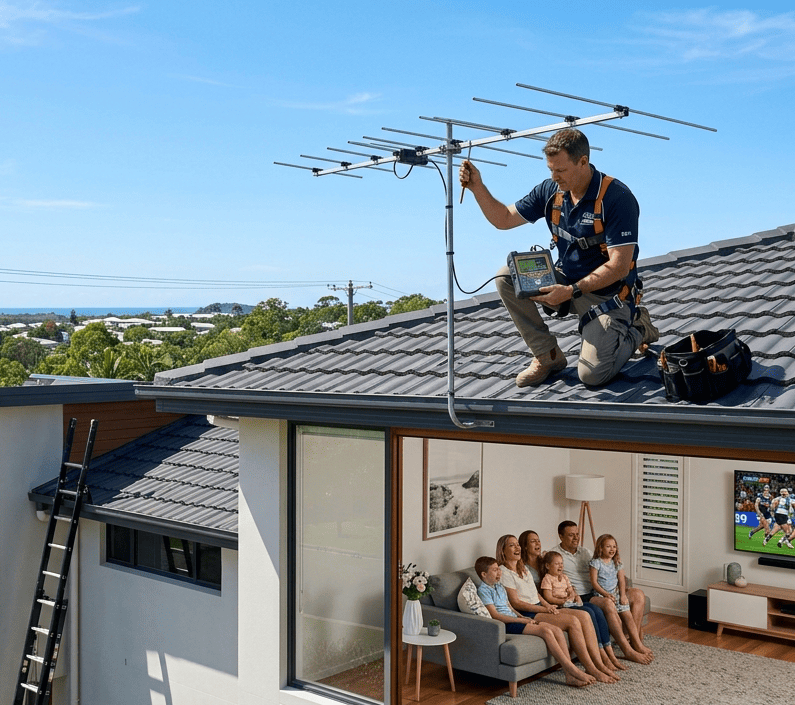
Even a small shift in antenna direction causes noticeable TV reception degradation on digital broadcasts. Wind, storm movement, or disturbance during roof work can take an antenna off its optimal angle without any visible signs of damage from the ground.
Your antenna must be pointed precisely at the nearest transmitter tower for the clearest possible signal. The ACMA’s TV reception checker allows you to confirm which transmitter serves your address and the expected signal strength in your area, which is useful before attempting a realignment.
If the antenna is accessible, minor adjustments can be tested by watching the picture quality change in real time. If it’s a roof installation, a professional alignment with a signal meter is the most reliable approach.
4. Reduce Sources of Interference
Electronic devices near your antenna cabling cause interference that degrades TV reception, often intermittently and in ways that are easy to attribute to other causes. Common culprits in Sunshine Coast homes include:
- LED downlights with poor shielding, particularly budget varieties
- 4G mobile network signals on frequencies adjacent to certain free-to-air channels
- Cordless phones and baby monitors operating on overlapping frequencies
- Routers and wireless access points positioned near TV cabling
Moving cabling away from power runs and wireless electronics, and switching to higher quality shielded coaxial where interference is suspected, reduces the impact significantly.
5. Run a Full Channel Rescan
Free-to-air broadcast frequencies occasionally change, and local transmitter upgrades can affect which channels your TV can find. A channel list that worked perfectly a year ago may now be missing channels that have shifted or been added.
Running a full auto-scan from your TV’s setup or settings menu takes a couple of minutes and refreshes the entire channel list. Do this after any antenna or cabling work, and any time you suspect your channel list may be incomplete.
For weather-specific TV reception issues where the signal drops during storms or heavy rain, our blog on fixing TV reception during bad weather covers those specific causes in more detail.
6. Add a Quality Signal Booster Where Appropriate
If your TV reception is consistently marginal rather than intermittently failing, a signal booster amplifies the incoming signal before it reaches your TV. This is the right fix when:
- You’re in a fringe reception area or further from the nearest transmitter tower
- Multiple TVs are sharing one antenna through a splitter
- Long cable runs between the antenna and TV are causing measurable signal loss
The important caveat is that a booster won’t fix a damaged antenna, misaligned unit, or faulty cabling. It amplifies whatever signal is already there, including noise and interference. Installing a booster on a faulty system makes things worse, not better.
Our TV antenna booster service includes signal testing before any amplification is recommended, so you know whether a booster will actually help in your specific situation.
7. Replace Cheap Splitters With Quality Distribution Hardware
Every time your television antenna signal is split to feed an additional TV, each point receives less signal. Budget splitters compound this loss with their own internal inefficiency, sometimes losing as much signal to the splitter itself as to the split.
If your home has multiple TV points and some receive weaker signal than others, replacing cheap splitters with quality distribution amplifiers sized correctly for your system is a straightforward improvement that doesn’t require touching the antenna at all.
8. Clean and Inspect the Antenna Unit
Outdoor antennas accumulate dust, corrosion, and debris over time. Queensland’s coastal conditions accelerate oxidation on metal elements, which reduces the antenna’s effective gain without any visible structural damage.
An annual inspection of the antenna unit, its mounting hardware, and any outdoor cable connections keeps the system in good condition and catches early signs of deterioration before they become major reception problems.
Our local TV antenna service includes visual inspection and condition assessment as part of every service visit.
9. Check for New Obstructions
Trees grow. New buildings go up. Neighbouring properties add extensions. Any of these can reduce the line-of-sight between your antenna and the transmitter tower, degrading TV reception fix Sunshine Coast wide without any change to your actual antenna system.
If your reception has worsened gradually over months rather than dropping suddenly, a new obstruction in the signal path is worth considering. Repositioning the antenna higher or to a different part of the roof sometimes resolves this entirely.
When the Antenna Does Need Replacing
If you’ve worked through all of the above and the TV reception problem persists, signal testing is the most reliable way to determine whether the antenna itself is the issue. Weak signal at the antenna point that doesn’t improve with cleaning or realignment, combined with visible corrosion or physical damage, usually confirms replacement is the right call.
See what other Sunshine Coast locals think of our work by reading what our customers say before you book.
Explore our full range of antenna, TV mounting, home theatre, and WiFi services at Brocky’s TV.
Call us on 0754059022, Monday to Friday during business hours.
Contact us today to book your signal assessment or get a no-obligation quote on any TV reception fix Sunshine Coast wide.
FAQs
1. Can I improve TV reception without touching the antenna?
Yes, in many cases. Reseating cable connections, replacing damaged cabling, reducing interference sources, and running a channel rescan all improve reception without any antenna work.
2. Why does my TV reception break up only in the evenings?
Evening signal problems usually indicate reception hovering close to the digital threshold. Temperature changes between day and night affect signal propagation from the transmitter, and a marginal signal dips below the threshold when conditions change. A booster or antenna realignment typically resolves this.
3. Will a signal booster definitely improve my TV reception?
Only if the signal is genuinely weak at your antenna. A booster won’t fix a damaged antenna, faulty cabling, or interference. Signal testing before installing a booster confirms whether it will help or not.
4. Why do I lose certain channels but not others?
Different channels broadcast on different frequencies. Losing specific channels usually means your antenna isn’t optimised for those frequencies, or there’s interference on a particular band. This is common on the Sunshine Coast and is typically resolved through realignment or a channel rescan.
5. How often should I inspect my outdoor antenna system?
An annual inspection is a sensible routine for most Sunshine Coast homes. Queensland’s climate accelerates corrosion and UV degradation on outdoor equipment, and catching small issues early prevents major reception failures later.