

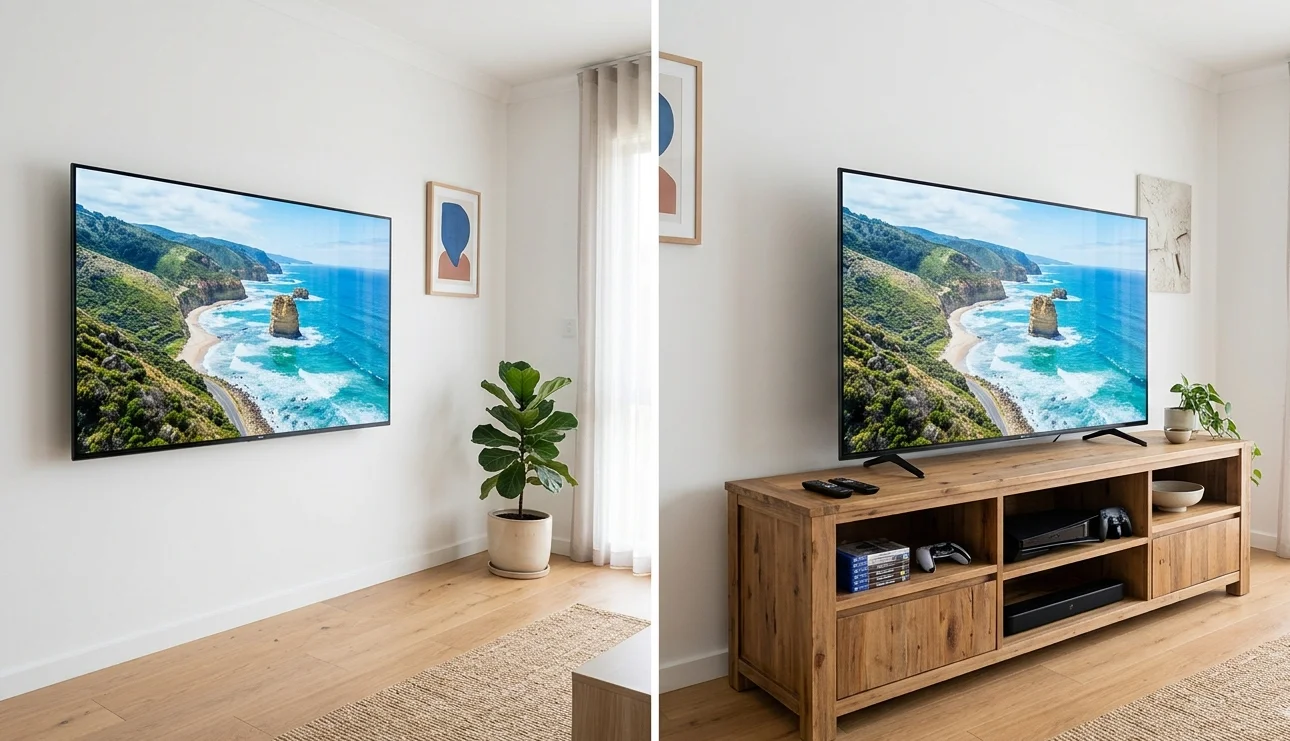
It’s one of the first decisions you make when setting up a new television, and it shapes how the room looks and functions for years to come. Choosing between a wall mounted TV and a TV stand isn’t just an aesthetic preference it affects viewing comfort, safety, cable management, room flexibility, and how much space you actually have to work with.
At Brocky’s TV, we handle professional TV wall mounting on the Sunshine Coast every week. We also have plenty of conversations with homeowners who aren’t sure which option actually suits their situation. Here’s an honest breakdown of both to help you make the right call.
The Case for a Wall Mounted TV
For most modern Sunshine Coast homes, a wall mounted TV is the preferred setup once households actually experience it. Here’s why.
1. A Cleaner, More Intentional Look
A wall mounted TV sits flush against the wall and removes the visual clutter of a stand, cabinet, or bracket system beneath it. In open-plan living areas, this creates a genuinely cleaner aesthetic that looks designed rather than assembled.
Paired with proper cable management, either hidden inside the wall or routed through a surface-mounted conduit, the result is a setup that looks like it belongs in the room rather than sitting in front of it.
2. Better Viewing Height and Angle
One of the most consistent complaints about TV stands is that the screen ends up either too low on a coffee table-height unit or uncomfortably high on a tall cabinet. A wall mounted TV is positioned at exactly the right height for your room’s seating layout, and the height is set specifically for how your household watches television.
A tilting or full-motion mount adds further control, allowing the screen angle to be adjusted for different seating positions or to eliminate glare from Sunshine Coast afternoon sun coming through windows.
3. Space and Furniture Savings
A wall mounted TV eliminates the need for a dedicated TV unit entirely where space is at a premium. In smaller Sunshine Coast living areas, units, or apartments, removing a TV stand frees up significant floor space and can make a room feel noticeably more open.
4. Improved Safety
A television on a stand is a topple risk, particularly in homes with young children or pets. A properly installed wall mounted TV, anchored correctly into studs or masonry, is significantly more secure. Product safety data consistently shows that television tip-over incidents are a genuine hazard in Australian homes, making wall mounting the safer choice for family households.
For reference on what Australian safety standards say about television securing, Product Safety Australia’s toppling furniture and television guide is the authoritative resource for Australian households.
5. Better for Larger Screens
As television sizes have increased, the stability of stand-based setups has become a more significant concern. An 85-inch television on a standard stand is a very different proposition to the same screen mounted properly to a wall. Larger televisions are almost always better served by wall mounting.
When a TV Stand Makes More Sense
A wall mounted TV isn’t the right choice for every situation. A stand-based setup has practical advantages in specific circumstances.
1. Rental Properties

If you’re renting on the Sunshine Coast and your tenancy agreement doesn’t permit wall fixings, a stand keeps your options open without risking bond issues. Some landlords do permit mounting with appropriate wall patching on departure, but it’s worth confirming before booking an installation.
2. No Suitable Wall Available
Not every room has a wall that works for a television mount. Large windows, feature walls that can’t be modified, alcoves with insufficient depth, or room layouts where no wall faces the seating area directly may simply not support a wall mounted TV regardless of preference.
3. Frequent Repositioning
A television on a stand can be moved to a different room or taken to a new property without any additional work. If your household moves frequently, rearranges rooms regularly, or uses the television in different locations throughout the year, a stand preserves that flexibility.
Key Decisions Before You Mount Your TV
If a wall mounted TV is the right choice for your home, a few key decisions determine how well the installation works in practice.
Wall Type and Construction
Wall type affects the hardware required and the installation complexity.
- Plasterboard walls require anchoring into studs or using load-rated cavity wall fixings
- Brick and masonry walls need masonry anchors and appropriate drilling equipment
- The wall needs to be assessed for the bracket’s weight rating before anything is purchased
Mount Type Selection
- Fixed mounts sit the television close to the wall with no adjustment, delivering the cleanest look
- Tilting mounts allow the screen angle to be adjusted downward, useful when the position is higher than ideal
- Full-motion or articulating mounts swing out and rotate, ideal for corner installations or rooms with multiple seating positions
Cable Management
In-wall cable management delivers the cleanest finish and involves running cables inside the wall cavity. Surface-mounted cable ducts provide a tidy result without in-wall work and suit rental situations or properties where in-wall work isn’t practical.
As covered in how VESA mount standards define TV mounting specifications, wall mount compatibility is determined by the television’s VESA pattern, which specifies the spacing between the four mounting points on the back of the screen, making this a critical specification to confirm before any bracket is purchased.
For Sunshine Coast households wanting professional installation with correct wall assessment, cable management, and full signal testing, TV wall mounting on the Sunshine Coast covers every step from site assessment to completed installation.
If your installation is in Caloundra specifically, TV installation in Caloundra is handled by the same experienced local team with the same professional approach.
If you’re also experiencing reception issues once your wall mounted TV is set up, TV pixelating causes and fixes covers the most common signal quality problems and what to do about them.
Why Sunshine Coast Locals Trust Brocky’s TV for Wall Mounting
We’re a local service, not a national franchise. When you book Brocky’s TV, an experienced local technician assesses your wall type, confirms the right mount and position for your room layout, installs everything correctly, and manages the cables cleanly before leaving.
Here’s what you get with every professional TV wall mounting on the Sunshine Coast at Brocky’s TV:
- Experienced technicians across all wall types including plasterboard, brick, and masonry
- Correct mount specified for your television’s size, weight, and VESA pattern
- Structural assessment and stud finding before any holes are made
- Full cable management included as standard
- Transparent, upfront pricing with no surprises
We’ll let the locals we’ve helped do the talking.
Book Your Wall Mounted TV Installation Today
If you’ve decided a wall mounted TV is the right choice, get it done properly the first time. A professional installation takes less than an hour in most Sunshine Coast homes and delivers a result that looks significantly better and lasts far longer than a DIY attempt with the wrong fixings.
From wall mounted TV installations to antenna services and Smart TV setup across the Sunshine Coast, you can find everything we do at Brocky’s TV.
Contact Brocky’s TV today and we’ll have your television mounted, cabled, and ready to watch as soon as possible.
FAQs
1. Is a wall mounted TV better than a TV stand?
For most modern Sunshine Coast homes, yes. A wall mounted TV delivers a cleaner look, better viewing height, improved safety, and frees up floor space. A stand suits rentals, frequently moved setups, or rooms without a suitable wall.
2. How high should a wall mounted TV be positioned?
The centre of the screen should sit at roughly eye level when seated, typically between 100 and 120 centimetres from the floor depending on your seating height. A tilting mount allows fine adjustment after installation.
3. What wall types can a TV be mounted on?
Plasterboard, brick, concrete, and masonry walls all support TV mounting with the correct hardware. Each requires a different approach, and a professional assessment confirms the right fixings before any holes are made.
4. Do I need professional installation for a wall mounted TV?
For plasterboard walls, confident DIY installation is possible if you can locate studs. For brick, masonry, or any uncertainty about wall structure or load capacity, professional installation is strongly recommended.
5. Does Brocky’s TV include cable management with wall mounting?
We mount televisions of all sizes from small bedroom sets through to large 85 and 98-inch screens, across all mount types including fixed, tilting, and full-motion brackets.