

TV wall mounting on a plaster wall looks straightforward until it isn’t. Plaster responds very differently to drilling pressure, weight, and movement compared to modern plasterboard or solid brick, and getting it wrong means cracked walls, a wobbly bracket, or worse, a TV that comes off the wall entirely.
At Brocky’s TV, we carry out professional TV wall mounting across the Sunshine Coast every week, including on the plaster walls found in many of the region’s older homes. Here’s a practical, honest guide to what’s involved in doing it safely.
Why Plaster Walls Require a Different Approach
Modern homes are built with plasterboard, also called gyprock or drywall, which is relatively predictable to work with. Plaster walls, found in homes built before the 1980s, are a different matter entirely.
Traditional plaster is applied in layers over timber lath or solid backing and can be significantly thicker, more brittle, and more prone to cracking than modern plasterboard. The wall construction also varies considerably between older homes, meaning what works in one property may cause problems in another.
The key difference for TV wall mounting is that plaster requires more careful preparation, gentler drilling technique, and the correct anchors for your specific wall construction.
Step 1: Identify What’s Behind Your Plaster Wall
Your mounting approach depends entirely on what’s underneath the plaster surface. The three most common backing materials in Sunshine Coast homes are:
- Timber studs with plaster applied over lath — found in most pre-1970s homes. Locating and mounting into studs is the most secure method.
- Solid masonry — brick or concrete with plaster applied directly over the top. Requires masonry anchors and a hammer drill.
- Hollow cavity with plaster — less common but occasionally found in partition walls. Requires specialised toggle bolt anchors.
A stud finder confirms whether there are studs behind the plaster and where they sit. Tapping the wall and listening for the change from hollow to solid is another reliable method. In older homes with lath-and-plaster construction, stud spacing is typically around 400 to 450 millimetres.
Step 2: Choose the Right Mounting Bracket
Not all TV wall mounting brackets suit plaster walls. Heavy articulated arms that swing and extend put continuous stress on the mounting points, which is problematic on plaster if those points aren’t properly anchored into studs.
For plaster walls, the most appropriate bracket types are:
- Fixed flat-mount brackets — the most stable option, sit the TV close against the wall with minimal stress on mounting points
- Tilt brackets — allow downward angle adjustment and are suitable for plaster when properly anchored into studs
- Full-motion articulated brackets — only appropriate on plaster walls when both mounting points are firmly secured into studs, not just anchors
Whatever bracket you choose, confirm it’s rated for the weight of your TV and compatible with your TV’s VESA hole pattern before purchasing.

Step 3: Locate and Use the Studs
Mounting directly into timber studs is the gold standard for TV wall mounting on plaster walls. The studs provide structural support that the plaster itself cannot reliably provide, particularly for larger and heavier screens.
Once you’ve located the studs with a finder or by tapping, mark their centres clearly. Ideally, your bracket’s mounting holes will align with two studs for maximum stability. If they don’t, you have two options: shift the TV position slightly, or use a timber mounting plate spanning across multiple studs to create a solid backing surface.
Step 4: Use the Correct Anchors When Studs Aren’t Available
If studs aren’t positioned where you need them, specialist hollow-wall anchors rated for plaster are the alternative. The most reliable options for TV wall mounting on plaster include:
- Toggle bolts, which expand behind the plaster and distribute load across a wider area
- Snap toggles, which lock into position and can be reused if the bolt is removed
- Spring toggles, which are suitable for lighter loads on thinner plaster sections
For TVs above 55 inches or heavier than 30 kilograms, stud mounting is strongly recommended regardless of anchor type.
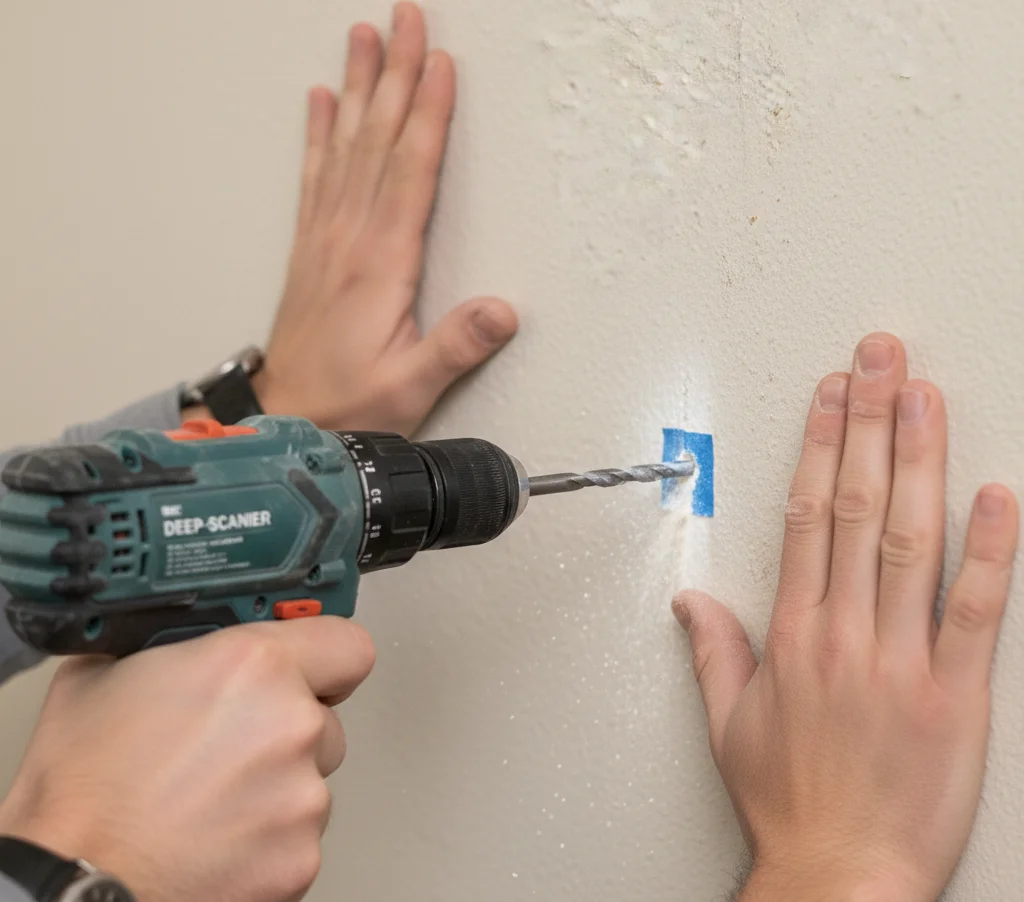
Step 5: Drill Carefully to Avoid Cracking
Plaster cracks are the most common consequence of incorrect drilling technique. To minimise the risk:
- Always start with a pilot hole smaller than the final anchor or screw size
- Use a standard drill on its lowest speed setting, never a hammer drill on plaster
- Apply consistent, gentle pressure rather than forcing the drill
- Place masking tape over the drill point before starting to reduce surface cracking around the hole
If the plaster sounds hollow but you can see what appears to be a stud location, probe gently with a thin finishing nail first to confirm before drilling the full hole.
Step 6: Manage Your Cables Cleanly
Cable management is often the finishing detail that determines whether a TV wall mounting looks professional or like an afterthought. On plaster walls, running cables inside the wall requires more care than on plasterboard because cutting into plaster is more involved.
Practical cable management options for plaster walls:
- Surface-mounted cable raceways or channels, painted to match the wall
- External trunking routed behind furniture or along skirting boards
- In-wall conduit, installed by a professional where the wall structure allows it
For a more detailed walkthrough of cable management options alongside TV wall mounting, our overview of TV wall mounting setup and cable management covers the full range of approaches.
Step 7: Check Viewing Height Before Drilling
The most common regret from DIY TV wall mounting jobs is drilling at the wrong height. Once the holes are in, adjusting by even 10 centimetres means new holes and filling the old ones.
Before any drilling, hold the bracket against the wall at your intended height and sit in your primary viewing position. The centre of the screen should align with seated eye level, not where the TV looks good standing up or from across the room.
For Sunshine Coast households wanting a professional assessment of height, viewing angle, and bracket selection before anything is drilled, our smart TV setup service includes height optimisation as part of every installation.
When to Call a Professional
Some plaster wall situations are better handled by a professional from the start:
- The plaster is visibly cracked, soft, or uneven
- You cannot locate studs or confirm what’s behind the wall
- Your TV is larger than 65 inches or heavier than 35 kilograms
- You want cables concealed inside the wall
- The bracket doesn’t align with available stud positions
Our TV mounting service on the Sunshine Coast handles all of these scenarios with proper tools, stud-finding equipment, and the experience to get the result right on the first visit.
CHOICE’s TV mounting safety guide provides independent Australian guidance on bracket selection and weight limits that’s worth reading before any DIY installation attempt.
See what other Sunshine Coast locals think of our work by reading what our customers say before you book.
Book Your Professional TV Wall Mounting Today
Getting TV wall mounting right on plaster means the right preparation, the right hardware, and careful execution. If any part of that process feels uncertain, professional installation is the most cost-effective option when you consider the alternative.
Explore our full range of mounting, antenna, home theatre, and smart TV services at Brocky’s TV.
Call us on 0754059022, Monday to Friday during business hours.
Contact us today to book your TV wall mounting on the Sunshine Coast or get a no-obligation quote.
FAQs
1. Can you safely mount a TV on a plaster wall?
Yes, with proper preparation. The key is identifying studs or using appropriate toggle bolt anchors rated for the TV’s weight. Drilling technique and bracket selection matter significantly on plaster walls.
2. What anchors are best for mounting a TV on plaster without studs?
Toggle bolts and snap toggles distribute load across a wider area and are the most reliable options for plaster walls. For TVs above 55 inches, stud mounting is always preferable.
3. Why can’t I use a hammer drill on plaster?
Hammer drills apply percussive force that easily cracks plaster, particularly around the drill point. A standard drill on low speed with a pilot hole first is the correct technique.
4. How high should a TV be mounted on a plaster wall?
The centre of the screen should align with seated eye level. In most living rooms this puts the bottom edge of a 65-inch TV at approximately 90 to 110 centimetres from the floor. Always test the position while seated before drilling.
5. Do you mount TVs on plaster walls across all areas of the Sunshine Coast?
Yes. We service Noosa, Caloundra, Buderim, Nambour, Maroochydore, Coolum, and all surrounding Sunshine Coast areas.