

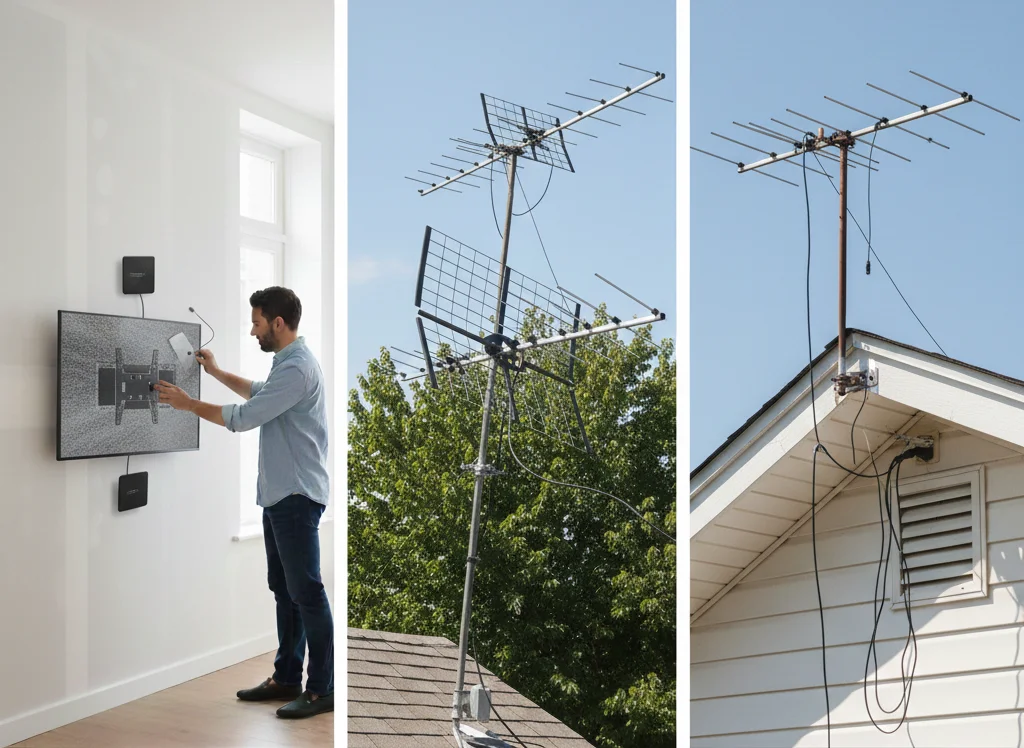
There’s a certain appeal to doing it yourself. A trip to the hardware store, a Saturday afternoon on the roof, and the promise of free-to-air television without paying for a professional. But TV antenna installation is one of those jobs where small mistakes produce big consequences, and most of them aren’t obvious until you’re back inside staring at a pixelated screen or a “No Signal” message.
At Brocky’s TV, we carry out professional TV antenna installation on the Sunshine Coast regularly, and a significant portion of our work involves fixing DIY installations that didn’t go as planned. Here are the most common mistakes we see and exactly what to do instead.
Why DIY TV Antenna Installation Goes Wrong
TV antenna installation looks straightforward from the ground. Mount the antenna, run the cable, plug it in, and scan for channels. In practice, there are a dozen decisions that affect the outcome, and getting any one of them wrong can mean the difference between a crystal-clear picture and a signal that drops every time a cloud passes over.
The Sunshine Coast’s geography, local broadcast tower locations, and coastal climate all add complexity that a generic YouTube tutorial won’t account for. Here’s what typically goes wrong.
The Most Common DIY TV Antenna Installation Mistakes
1. Choosing the Wrong Type of Antenna
Not every antenna suits every location, and choosing based on price or appearance rather than specifications is one of the most common TV antenna installation mistakes on the Sunshine Coast.
What goes wrong:
- A low-gain antenna installed in a fringe reception area too far from the Mt Cooroora or Gympie transmitter produces a weak, unreliable signal
- An antenna designed for metropolitan areas may be unsuitable for Sunshine Coast properties with hills, vegetation, or coastal interference in the signal path
- Compact indoor antennas installed in homes where an outdoor aerial is needed never perform adequately regardless of placement
What to do instead:
- Identify your nearest broadcast transmitter and measure your approximate distance before selecting any hardware
- Match the antenna’s gain rating to your location’s signal strength requirements
- Choose an outdoor UHF antenna for most Sunshine Coast properties, and a high-gain directional model for locations further from the transmitter
2. Incorrect Antenna Pointing and Alignment
An antenna that’s physically installed but pointing in the wrong direction will never deliver the signal strength it’s capable of. This is one of the easiest mistakes to make and one of the most common reasons a DIY TV antenna installation underperforms.
What goes wrong:
- Pointing the antenna toward the nearest visible tower rather than the broadcast transmitter your local channels are assigned to
- Installing the antenna without checking the correct bearing using an app or ACMA’s broadcast coverage maps
- Assuming a visually level antenna is correctly aligned without checking the signal meter
What to do instead:
- Use the ACMA’s broadcast coverage checker to confirm which transmitter serves your Sunshine Coast address and what direction it’s located
- Use a signal strength meter during installation rather than relying on a channel scan after the fact
- Have someone monitor the signal meter indoors while adjustments are made on the roof
3. Using Poor Quality or Incorrect Cabling
The coaxial cable running from your antenna to your television is the signal’s only path. Using the wrong type, cutting corners on quality, or making poor connections degrades the signal before it ever reaches your TV.
Common cabling mistakes:
- Using RG59 cable instead of RG6, which has significantly better shielding and lower signal loss over distance
- Running excessive cable lengths without accounting for signal attenuation
- Using standard household tools rather than proper coaxial connectors and crimping tools
- Joining cable with poorly terminated inline connectors that introduce impedance mismatches
What to do instead:
- Use RG6 quad-shield coaxial cable for all runs from the antenna to wall plates and distribution points
- Keep cable runs as short as practically possible
- Use F-type connectors with proper termination rather than push-fit or tape joins
- Seal all outdoor connections with weatherproof tape or self-amalgamating tape to prevent moisture ingress
4. Poor Antenna Mounting and Physical Security
An antenna that isn’t properly secured to the roof or mounting pole creates two problems: it moves in wind, shifting alignment, and it’s a safety hazard.

What goes wrong:
- Using undersized mounting brackets that can’t support the antenna in strong coastal winds
- Not treating all mounting hardware with corrosion-resistant coating or using non-stainless fixings that rust within months in the Sunshine Coast’s salt air environment
- Mounting the antenna below the roofline where it’s partially shielded from the signal
What to do instead:
- Use stainless steel or galvanised mounting hardware throughout
- Ensure the antenna is mounted at or above the roofline with a clear line of sight toward the transmitter
- Check and tighten all mounting hardware after the first storm
5. Ignoring Signal Splitting and Distribution
Many Sunshine Coast homes have televisions in multiple rooms, and splitting the antenna signal without proper planning is a common cause of weak reception that appears immediately after a DIY TV antenna installation.
What goes wrong:
- Using a cheap passive splitter without accounting for the signal loss each split introduces, typically 3.5 dB per output
- Splitting a signal that’s already marginal produces a signal too weak for reliable reception at each endpoint
- Not balancing cable run lengths across a distribution system
What to do instead:
- Install a correctly specified distribution amplifier when splitting across multiple rooms, particularly if the incoming signal is not already strong
- For homes with four or more TV points, a masthead amplifier installed at the antenna itself delivers the best results
- For a properly specified amplifier for your specific setup, TV antenna boosters and amplifiers covers the options in detail
6. Skipping Earthing and Surge Protection
Antenna installations on the Sunshine Coast are exposed to the region’s regular electrical storms. A properly earthed antenna and coaxial surge protector protect both the installation and connected equipment.
What goes wrong:
- Leaving the antenna mast unearthed, which creates a direct lightning path into the home
- Not installing a coaxial surge protector at the entry point where the cable comes inside
- Using unprotected power boards for televisions and set-top boxes that are connected to an unearthed antenna system
What to do instead:
- Have the antenna mast earthed by a licensed installer as part of the installation
- Install a coaxial surge protector at the point where the cable enters the building
- Use surge-protected power boards for all equipment connected to the antenna system
For a broader look at the mistakes that affect signal quality and system longevity beyond just the installation process, 5 mistakes people make with DIY antenna installation covers additional pitfalls worth reading before you start.
As covered in how television reception and antenna systems work, antenna performance is directly affected by gain, directivity, installation height, and cable quality, making each of these decisions significant rather than minor details.
When to Call a Professional for TV Antenna Installation
DIY TV antenna installation can work in straightforward situations with strong local signals. But these are clear signs a professional installation will save you time, money, and frustration:
- Your property is in a fringe reception area or has obstacles between the antenna and the transmitter
- You need signal distributed to multiple rooms
- Previous DIY attempts haven’t produced reliable reception
- Your home is in a coastal area where storm damage and corrosion are significant concerns
- You want the installation earthed correctly for lightning protection
For professional TV antenna installation on the Sunshine Coast, TV antenna installation covers everything from site assessment and antenna selection to full installation, cabling, and signal testing across every room.
Why Sunshine Coast Locals Trust Brocky’s TV
We’re a local antenna service, not a national franchise. When you book Brocky’s TV, an experienced local technician assesses your property’s specific reception environment, selects the right hardware for your location, and installs everything correctly from the first visit.
Here’s what you get with every professional TV antenna installation on the Sunshine Coast at Brocky’s TV:
- Experienced technicians familiar with Sunshine Coast transmitter coverage and local reception challenges
- Correctly specified antennas, cabling, and distribution hardware for your property
- Full signal testing at every TV point before the job is complete
- Stainless and weatherproof hardware rated for the coastal environment
- Transparent, upfront pricing with no surprises
We’ll let the locals we’ve helped do the talking.
Book Your TV Antenna Installation Today
Don’t waste a weekend on a DIY TV antenna installation that doesn’t deliver. Whether it’s a new installation, a system upgrade, or fixing a previous DIY attempt, the team at Brocky’s TV is ready to help.
From TV antenna installation on the Sunshine Coast to antenna boosters, signal distribution, and reception troubleshooting, you can find everything we do at Brocky’s TV.
Contact Brocky’s TV today and we’ll have your antenna installed and your picture crystal clear as soon as possible.
FAQs
1. What is the most common DIY TV antenna installation mistake?
Incorrect antenna pointing is the most common fault. Without confirming the exact bearing to the nearest broadcast transmitter, even a correctly specified antenna will underperform.
2. What cable should I use for TV antenna installation?
RG6 quad-shield coaxial cable is the correct choice for all residential antenna installations. RG59 is an older standard with higher signal loss and inferior shielding.
3. Do I need a signal booster if I’m splitting to multiple rooms?
Almost always yes. Each passive split introduces signal loss that compounds across a system. A distribution amplifier or masthead amplifier is needed for reliable reception at multiple TV points.
4. Does the Sunshine Coast’s coastal environment affect antenna installations?
Yes significantly. Salt air accelerates corrosion on mounting hardware and outdoor connections. Stainless fixings, weatherproof sealant on all connections, and correct earthing are essential for longevity.
5. Can I install a TV antenna myself in Queensland?
The antenna and cabling itself can be DIY, but earthing the mast requires a licensed electrician. Signal quality and longevity are consistently better with professional installation on the Sunshine Coast.